
Building an email list is an exciting milestone for any online marketer. You’ve created a website, attracted visitors, offered a free resource, and convinced people to subscribe.
But here’s something many beginners overlook:
Getting subscribers is only the beginning. What you do after they join your list matters just as much.
Imagine spending weeks building an email list, only to discover that very few subscribers open your messages or click your links.
It’s frustrating, especially when you’ve worked hard to attract those subscribers.
The good news is that effective email marketing doesn’t have to be complicated.
You don’t need thousands of subscribers, expensive software, or years of marketing experience to begin developing relationships with your audience.
What you need is a clear strategy, helpful content, and a willingness to learn what your subscribers actually want.
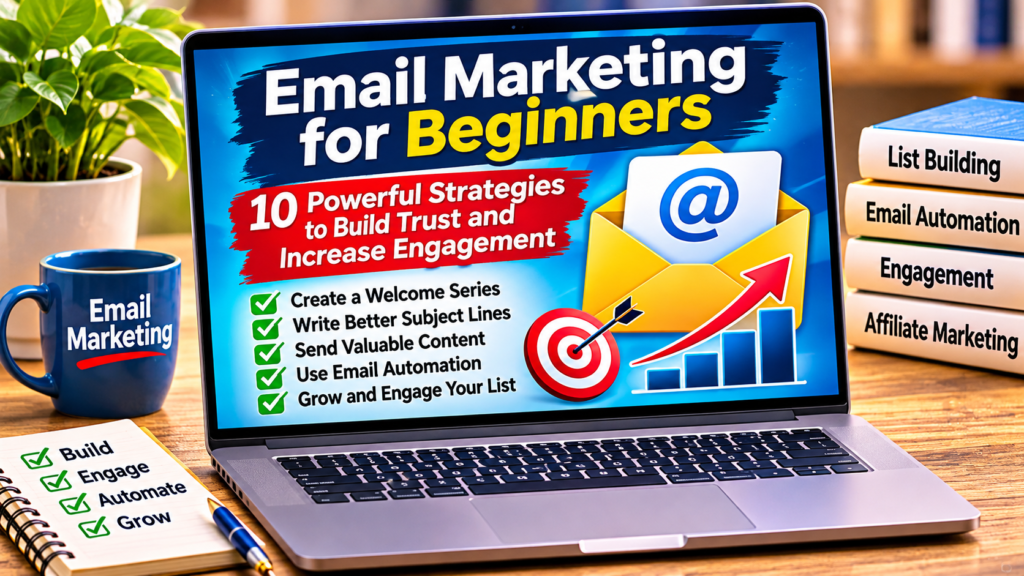
In this guide, we’ll explore 10 powerful email marketing strategies for beginners that can help you build trust, improve engagement, and create a stronger foundation for your online business.
Whether you’re promoting affiliate products, running a blog, or building your first online business, these principles can help you make better use of your email list.
Why Email Marketing for Beginners Is So Important
Email marketing remains a valuable communication channel because it allows businesses to connect directly with people who have chosen to receive their messages.
Unlike social media, where platform algorithms influence how many followers see your posts, email gives you a way to reach subscribers through their inboxes.
Of course, sending an email doesn’t guarantee that someone will receive, open, or read it. Deliverability, subscriber interest, and email provider filtering all affect results.
However, an engaged email list can provide an important connection between your content and your audience.
For affiliate marketers, email marketing can also help introduce products in a more thoughtful way.
Instead of immediately sending someone to a sales page, you can provide useful information, answer questions, and explain how particular resources might solve a problem.
The goal isn’t simply to send more emails.
The goal is to send emails that people find worth opening.
Let’s explore how to accomplish that.
1. Start With a Clear Email Marketing Goal
Before creating an email campaign, ask yourself what you want to accomplish.
Are you trying to educate subscribers?
Encourage them to read your blog?
Build relationships with potential customers?
Introduce relevant affiliate products?
Or simply stay connected with people interested in your niche?
Your goal influences the type of content you should send.
Match your emails to your business objectives
For example, a blogger might use email marketing to share new articles and helpful resources.
An affiliate marketer might create a series of educational emails explaining a common problem before recommending a relevant solution.
Someone selling their own digital product might use email to answer frequently asked questions and introduce the product’s benefits.
These approaches can work together, but every email should have a reasonably clear purpose.
Avoid trying to accomplish everything in one email
A common beginner mistake is including too many unrelated messages.
An email might contain three affiliate offers, two blog links, several announcements, and multiple calls to action.
That can overwhelm readers.
Instead, focus on one primary topic and one main action.
For example:
“Today I’m sharing three ways to improve your email signup page.”
Then explain those three ideas and invite readers to explore a related resource if appropriate.
A focused message is generally easier to understand.
2. Create a Strong Welcome Email
Your welcome email is one of the most important messages in your entire email marketing strategy.
It’s often the first direct communication someone receives after joining your list.
That makes it an opportunity to create a positive first impression.
What should a welcome email include?
Start by thanking the subscriber for joining.
If you promised a free report, checklist, or other resource, deliver it promptly.
Explain what kind of information you’ll share and how often subscribers can generally expect to hear from you.
Keep the tone friendly and conversational.
You might write something like:
“Thanks for joining! I’m glad you’re here. My goal is to share practical online marketing tips that can help you build your business one step at a time.”
Then provide the promised resource.
Make the first email useful
Avoid turning your welcome email into a long sales pitch.
Someone who just subscribed may not know much about you yet.
Start by fulfilling your promise.
You can introduce additional resources in later messages.
Consider a short welcome sequence
Instead of sending only one email, you might create a simple series.
For example:
- Email 1: Welcome and deliver the free resource.
- Email 2: Share a useful beginner tip.
- Email 3: Explain a common mistake.
- Email 4: Recommend a helpful blog article.
- Email 5: Introduce another relevant resource.
This gives new subscribers several opportunities to become familiar with your content.
3. Write Subject Lines That Encourage Opens
Your email subject line plays an important role in whether subscribers decide to open your message.
People receive many emails every day.
If your subject line is confusing, irrelevant, or overly promotional, they may ignore it.
What makes a good subject line?
A useful subject line should communicate a clear idea.
It should create interest without misleading the reader.
For example:
Weak subject line:
“AMAZING SECRET YOU MUST SEE!!!”
Better subject line:
“3 Simple Ways to Improve Your Email Signup Page”
The second example tells readers what they’ll learn.
Another example:
Weak subject line:
“You Won’t Believe This Incredible Opportunity!”
Better subject line:
“One Email Marketing Mistake Beginners Often Make”
The second version creates curiosity while remaining connected to the content.
Avoid misleading promises
Don’t claim that subscribers have won something, received money, or must act immediately unless those statements are accurate.
Misleading subject lines can damage trust and create problems with email marketing rules.
Instead, focus on relevance and clarity.
Experiment with different approaches
You might test subject lines that use:
- A practical benefit.
- A question.
- A numbered tip.
- A common mistake.
- A specific problem.
Review the results over time.
Remember that email open rates aren’t perfectly accurate because privacy features can affect tracking.
Clicks and other meaningful actions can provide additional insight.
4. Focus on Providing Value Before Promoting Products
One of the most important email marketing strategies for beginners is learning to balance helpful content with promotions.
If every email contains an affiliate link and little useful information, subscribers may quickly lose interest.
Instead, give people reasons to remain on your list.
What does valuable email content look like?
Suppose your audience consists of beginners interested in affiliate marketing.
You could send emails about:
- Choosing a profitable niche.
- Creating useful blog content.
- Avoiding common affiliate marketing mistakes.
- Building an email list.
- Understanding traffic sources.
- Improving landing pages.
- Using AI tools responsibly.
Each topic offers an opportunity to help subscribers solve a problem.
Use a simple teaching approach
A helpful email doesn’t need to be long.
You can structure it around three elements:
Identify a problem.
Explain something your audience may be struggling with.
Share a practical solution.
Provide one or two useful steps.
Suggest a next action.
Invite subscribers to apply the advice or explore an additional resource.
For example, an email about low signup rates could explain why a complicated subscription form may discourage visitors.
Then suggest testing a shorter form with a clearer headline.
That’s useful even if the reader never clicks an affiliate link.
When subscribers consistently receive helpful information, you give them a stronger reason to stay connected.
5. Use Email Automation to Save Time
Email automation allows you to prepare messages in advance and deliver them according to a schedule or subscriber activity.
This can be especially useful if you’re managing an online business alongside a full-time job or other responsibilities.
Instead of manually writing and sending every message, you can create a sequence that welcomes and educates new subscribers.
How does an automated email sequence work?
Imagine someone subscribes to receive your free affiliate marketing guide.
Your email platform could automatically send:
Day 1: Welcome message and download link.
Day 3: A beginner-friendly affiliate marketing tip.
Day 5: Common mistakes to avoid.
Day 7: A helpful article about getting website traffic.
Day 10: Advice about building trust with an audience.
Day 14: A relevant resource or product recommendation.
These are example intervals, not a universal schedule.
The appropriate timing depends on your audience and the expectations you set.
Choose an email marketing platform
You’ll need a service that can manage subscribers, send campaigns, and support automated follow-ups.
One option is AWeber, which offers email automation, signup forms, and tools for managing subscriber communications.
For beginners, the most important thing isn’t having every advanced feature.
It’s understanding how to create a list, connect a signup form, and deliver useful messages reliably.
Don’t automate without reviewing
Automation saves time, but it shouldn’t become an excuse to ignore your subscribers.
Review your messages periodically.
Check that links still work.
Update outdated recommendations.
Remove references to expired offers.
Make sure your sequence still matches what subscribers signed up to receive.
A useful automated sequence should remain accurate and relevant.
6. Make Your Emails Personal and Conversational
People often respond better to messages that sound like they were written by a real person rather than a large advertising department.
That doesn’t mean you need to share every detail of your life.
It means writing clearly and naturally.
Write to one reader
Instead of imagining that you’re addressing thousands of people, picture one person who needs help with a specific problem.
Use words such as “you” and “your.”
Keep sentences understandable.
Avoid unnecessary jargon.
For example:
Formal approach:
“It is imperative that subscribers implement an optimized lead acquisition methodology.”
Conversational approach:
“If you’re struggling to get subscribers, start by making your free offer easier to understand.”
The second version communicates the same general idea more naturally.
Share useful experiences
You can also explain something you’ve learned while building your business.
Perhaps a landing page didn’t perform as expected.
Maybe you discovered that a simpler signup form was easier to use.
Or perhaps a particular blog article generated more interest than you anticipated.
Sharing genuine experiences can make your emails more relatable.
Just be careful not to exaggerate results.
Invite replies
Occasionally, ask subscribers a simple question.
For example:
“What’s your biggest challenge with email marketing right now?”
Not everyone will respond.
But the replies you receive may help you understand what your audience wants to learn.
7. Segment Your Email List When It Makes Sense
As your email list grows, you may discover that subscribers have different interests.
Some might be beginners learning affiliate marketing.
Others may be interested in blogging, social media, or email automation.
Sending exactly the same message to everyone isn’t always the best approach.
That’s where email segmentation comes in.
What is email segmentation?
Segmentation means organizing subscribers into groups based on relevant characteristics or interests.
For example, you might create groups for:
- Affiliate marketing beginners.
- Blogging and SEO enthusiasts.
- Email marketing learners.
- Existing customers.
- Subscribers interested in AI marketing tools.
You could then send content that better matches each group’s interests.
Why segmentation can help
Imagine someone subscribes because they want to learn about blogging.
If most of your emails suddenly focus on unrelated products, they may lose interest.
But if you share relevant blogging advice and occasional related resources, the content may feel more useful.
Keep segmentation simple
Beginners don’t need dozens of complicated subscriber categories.
Start with one list and a clear content focus.
As you gain subscribers and learn more about their interests, consider introducing tags or segments.
The purpose is to improve relevance, not create unnecessary administrative work.
8. Connect Email Marketing With Your Blog
Your website and email list can support one another.
A blog helps people discover your content through search engines and other traffic sources.
Email marketing gives interested readers another way to stay connected.
Together, they can form a practical content marketing system.
Turn blog articles into email ideas
Suppose you’ve written a detailed article about building trust in online marketing.
You don’t need to copy the entire article into an email.
Instead, choose one useful takeaway.
For example:
“One of the easiest ways to lose trust is to recommend products you haven’t properly evaluated. Before sharing an affiliate offer, take time to understand what it provides and who it may help.”
Then invite interested readers to explore your complete article.
You can apply the same approach to articles about blogging, traffic generation, and list building.
Help subscribers discover related resources
If someone is learning how to attract website visitors, they might appreciate a guide explaining how to turn those visitors into subscribers.
For example, you can read my article on how to turn website visitors into email subscribers.
You can also explore my guide on how to get free traffic for affiliate marketing.
These resources address related challenges.
Make sure the links you share are relevant to the email’s topic.
Avoid sending only promotional announcements
Not every email needs to announce a new blog article or product.
Some emails can contain a complete tip that subscribers can use immediately.
This gives readers value without requiring them to leave their inbox.
9. Recommend Affiliate Products Naturally
Affiliate marketing and email marketing can work together, but the way you introduce products matters.
A common mistake is promoting whatever offer promises the highest commission.
That approach may generate occasional clicks, but it doesn’t necessarily help you build a loyal audience.
Instead, recommend resources that match your subscribers’ interests.
Start with the problem
Suppose your subscribers are learning how to create affiliate marketing content.
You might explain the challenges of researching topics, organizing articles, and preparing marketing materials.
Then you could discuss how AI tools may help streamline certain tasks.
If it’s relevant, you might introduce a resource such as my AI Affiliate Starter Kit.
The product recommendation follows naturally from the educational content.
Explain who the product is for
Rather than simply saying a product is amazing, explain what it offers and who may benefit.
Be clear about any limitations you know.
Avoid suggesting that purchasing a product guarantees income or business success.
Respect your subscribers
If someone joined your list for helpful marketing advice, don’t suddenly flood their inbox with unrelated offers.
Keep promotions relevant.
Disclose affiliate relationships clearly.
And make it easy for subscribers to unsubscribe.
The long-term value of your email list depends partly on maintaining trust.
10. Track Email Marketing Performance and Keep Improving
Once you’ve started sending emails, it’s important to understand how they’re performing.
You don’t need to become a data analyst.
Start with a few basic measurements.
Important email marketing metrics
Delivery and bounce rates
These can help you identify email addresses that aren’t accepting messages.
Open rates
These provide a rough indication of engagement, although privacy features can make them unreliable.
Click-through rates
These show whether subscribers are clicking links in your emails.
Unsubscribe rates
These can help you recognize when content or frequency may not match subscriber expectations.
Spam complaints
These are important warning signs that subscribers may not want your messages.
Conversions
If you’re promoting a product or encouraging another measurable action, conversions help you understand whether your emails are achieving their purpose.
How to calculate an email click-through rate
One common calculation is:
Click-Through Rate = (Unique Clickers ÷ Delivered Emails) × 100
For example, suppose an email is delivered to 500 subscribers and 25 unique subscribers click a link.
Your click-through rate would be:
(25 ÷ 500) × 100 = 5%
Different email platforms may use different reporting definitions, so check how your service calculates its metrics.
A 5% click-through rate isn’t a universal benchmark or guarantee of success.
Results vary by audience, industry, and campaign.
Look for patterns
Instead of judging your strategy by one email, review several campaigns.
Which topics generate the most interest?
Which links receive clicks?
Do subscribers respond to educational content?
Are certain subject lines consistently performing better?
Use those observations to guide future messages.
The goal is continuous improvement.
Common Email Marketing Mistakes Beginners Should Avoid
Even with a good strategy, beginners can make mistakes that reduce engagement.
Here are several worth watching for.
Sending emails without permission
Only send marketing emails to people who have given appropriate consent or where you have another valid legal basis.
Don’t assume that buying a list of email addresses gives you permission to market to everyone on it.
Failing to deliver a promised free resource
If someone subscribes to receive a report, make sure they can actually access it.
Test the download process before promoting your signup page.
Sending too frequently
If subscribers expect occasional educational emails but receive multiple promotions every day, they may become frustrated.
Set expectations and pay attention to feedback.
Disappearing for months
Long periods of silence can cause subscribers to forget who you are.
Choose a realistic schedule that you can maintain.
Using misleading subject lines
A subject line should accurately reflect the email’s content.
Ignoring mobile formatting
Many subscribers read emails on smartphones.
Use readable text, short paragraphs, and links that are easy to select.
Forgetting legal requirements
Marketing emails may need accurate sender identification, a valid physical mailing address, and a working unsubscribe mechanism, depending on applicable laws.
For example, U.S. commercial email is subject to CAN-SPAM requirements. Other jurisdictions may impose additional consent and privacy rules.
Promoting products without understanding them
Take time to evaluate what you’re recommending.
Your credibility matters more than a quick commission.
A Simple 30-Day Email Marketing Plan for Beginners
If you’re ready to improve your email marketing strategy, here’s a manageable plan.
Week 1: Review your foundation
Make sure your signup forms work properly.
Check that new subscribers receive their promised resources.
Review your welcome email.
Confirm that your sender information and unsubscribe process are correct.
Week 2: Create helpful content
Write three or four educational emails addressing common problems in your niche.
Keep each message focused on one useful takeaway.
Include relevant resources when appropriate.
Week 3: Improve your automation
Review your welcome sequence.
Add helpful follow-up messages if necessary.
Check that your links and product recommendations are current.
Make sure subscribers receive emails at reasonable intervals.
Week 4: Measure and adjust
Review your delivery, clicks, unsubscribes, and other available metrics.
Identify which topics generated the most interest.
Consider testing a different subject line or call to action.
Plan your next month based on what you’ve learned.
Remember, the purpose of this plan isn’t to produce immediate sales.
It’s to establish a repeatable process for communicating with your subscribers.
How Email Marketing Supports Long-Term Business Growth
One of the biggest advantages of email marketing is that it can complement several other online business activities.
Your blog can attract visitors through helpful articles.
Your social media accounts can introduce people to your content.
Your lead magnets can encourage interested visitors to subscribe.
Your email sequence can continue providing useful information after someone leaves your website.
And when you have a relevant product or service to recommend, you have an established communication channel for introducing it.
These pieces work together.
For example, someone might discover a blog article through Google, subscribe for a free guide, read several helpful emails, and eventually explore a product recommendation.
Not everyone will follow that path.
Some subscribers may simply enjoy your free content.
Others may unsubscribe.
But creating a useful system gives you opportunities to develop relationships over time.
The important thing is to keep improving each part of the process.
Email marketing works best when it becomes a way to serve your audience—not just another place to advertise.
Final Thoughts: Build an Email List People Want to Stay On
Email marketing for beginners doesn’t have to be overwhelming.
You don’t need to master every automation feature, create complicated sales funnels, or send messages every day.
Start with the basics.
Create a useful welcome email.
Share helpful information.
Write clear subject lines.
Keep your messages conversational.
Use automation to save time.
Recommend products that genuinely fit your audience.
And review your results so you can improve.
Most importantly, remember that every subscriber represents a real person who chose to hear from you.
Respect that decision.
Provide useful content.
Be consistent.
And focus on building relationships that can last.
A successful email list isn’t simply a collection of addresses. It’s an audience that has reasons to trust you, learn from you, and continue opening your emails.
Affiliate Disclosure: This article contains affiliate links. If you purchase through one of these links, I may earn a commission at no additional cost to you. Results and earnings are not guaranteed.