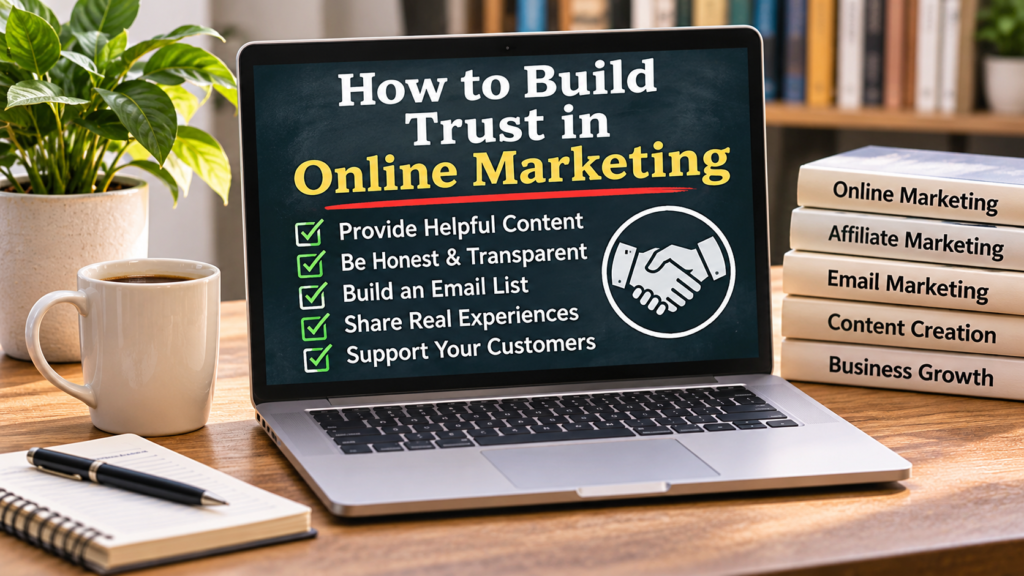

Getting people to visit your website is only part of building a successful online business.
What happens after they arrive is just as important.
You might have an attractive website, helpful blog articles, and excellent products to recommend. But if visitors don’t trust you, they’re unlikely to subscribe to your email list, follow your recommendations, or make a purchase.
That’s why learning how to build trust in online marketing is one of the most valuable skills you can develop.
Trust doesn’t happen overnight. It grows when you consistently provide useful information, communicate honestly, and show people that you genuinely want to help them.
Whether you’re promoting affiliate products, selling your own digital products, or building an email list, the following nine strategies can help you develop stronger relationships with your audience.
Why Learning How to Build Trust in Online Marketing Matters
Think about the last time you considered purchasing something from a website you’d never visited before.
You probably had a few questions.
Was the website legitimate? Would the product deliver what was promised? Was the information accurate? Could you contact someone if something went wrong?
Your potential customers have similar concerns.
Online marketing involves asking people to take action, sometimes before they’ve ever spoken with you.
That action might be clicking a link, sharing an email address, or spending money.
The more confidence people have in your business, the more comfortable they may feel taking that next step.
However, trust should never be treated simply as a technique for getting someone to buy.
Trust is something you earn by treating people fairly, providing value, and following through on your promises.
Let’s explore how to make that part of your marketing strategy.
1. Create Helpful Content Before Promoting Products
One of the easiest ways to lose someone’s attention is to immediately bombard them with sales pitches.
Imagine visiting a blog because you want to learn how to start affiliate marketing.
Instead of finding useful information, every paragraph tells you to purchase a product.
Would you keep reading?
Probably not.
Now imagine discovering an article that explains the process step by step, answers your questions, and helps you avoid common mistakes.
You would likely have a much better impression of that website.
That’s the difference between marketing that focuses only on selling and marketing that begins with helping.
How to put this into practice
Start by identifying problems your audience wants to solve.
If your niche is online marketing, useful topics might include:
- How to start an online business with a limited budget.
- How to create helpful blog content.
- How to build an email list.
- How to choose affiliate products.
- How to improve website conversions.
- How to understand marketing statistics.
Create articles that answer those questions thoroughly.
Then introduce relevant products only when they genuinely complement the information.
For example, if you’re explaining how beginners can use artificial intelligence to create marketing content, mentioning an appropriate AI marketing resource makes sense.
The key is relevance.
A recommendation should support the article, not become the entire purpose of the article.
2. Be Honest About What Products Can and Cannot Do
The online marketing industry is filled with exciting opportunities.
Unfortunately, it’s also filled with exaggerated promises.
You’ve probably seen advertisements claiming that a particular system can generate thousands of dollars with almost no effort.
Claims like these might attract attention, but they can also create unrealistic expectations.
And unrealistic expectations can lead to disappointed customers.
A more effective long-term approach is to explain both the benefits and limitations of what you’re recommending.
Set realistic expectations
Suppose you’re promoting software that helps users create marketing content.
You can explain how it might save time, generate ideas, or simplify certain tasks.
But you should also explain that users still need to review the content, understand their audience, and implement a marketing strategy.
Software doesn’t automatically create a profitable business.
Likewise, purchasing an affiliate marketing course doesn’t guarantee commissions.
Training can provide valuable knowledge, but results depend on how that knowledge is applied.
Being realistic doesn’t make your offer less attractive.
It helps customers understand what they’re actually purchasing.
And when people receive what they expected, they’re more likely to have a positive experience.
3. Make Your Website Look Professional and Easy to Navigate
Your website is often the first impression someone has of your online business.
It doesn’t need expensive graphics or complicated features.
In fact, a simple website can work extremely well when it’s organized and easy to use.
Visitors should be able to understand what your website is about within a few seconds.
They should also be able to find the information they’re looking for without becoming frustrated.
Important website elements
Clear navigation
Organize your articles into meaningful categories.
For example, a marketing website might have categories for affiliate marketing, online marketing, email marketing, and artificial intelligence.
Readable content
Use short paragraphs, descriptive headings, and sufficient spacing.
Mobile-friendly design
Many visitors browse websites on their phones. Make sure your pages are readable on smaller screens.
Contact information
Provide a reasonable way for visitors or customers to reach you.
About page
Explain who you are, what your website covers, and why you created it.
Privacy and disclosure information
Let visitors know how their information is handled and when your recommendations involve affiliate relationships.
You don’t have to build the perfect website before publishing your first article.
Start with a clean, functional design and improve it over time.
4. Build Relationships Through Email Marketing
Email marketing gives you an opportunity to stay connected with people after they leave your website.
Someone might read one article today and forget about your website tomorrow.
But if they voluntarily subscribe to your email list, you have a way to share additional helpful information.
This creates opportunities to build familiarity over time.
Start with a useful reason to subscribe
Instead of simply asking visitors to join your mailing list, explain what they’ll receive.
You could offer a free guide, checklist, report, or educational email series.
For example, a beginner interested in affiliate marketing might appreciate a free report explaining common mistakes to avoid.
Once someone subscribes, deliver what you promised.
Then continue sharing information relevant to their interests.
Use an email marketing service
An email marketing platform helps you organize subscribers and automate follow-up messages.
One option is AWeber, which provides tools for signup forms, newsletters, and automated email campaigns.
These features can be helpful when you’re building an audience while managing other responsibilities.
However, the software is only part of the process.
The content of your emails matters just as much.
Don’t make every email a sales pitch
Consider sending messages that include:
- Helpful marketing tips.
- Links to new blog articles.
- Answers to common questions.
- Lessons you’ve learned.
- Useful resources.
- Occasional relevant product recommendations.
When subscribers consistently receive something worthwhile, they have more reasons to open future messages.
And remember to respect unsubscribe requests and obtain appropriate consent before sending marketing emails.
A smaller, engaged email list can be more useful than a large list of people who aren’t interested in your content.
5. Share Your Experiences and Lessons Learned
You don’t have to pretend you’ve mastered every aspect of online marketing.
In fact, sharing what you’re learning can make your content more relatable.
Many beginners feel overwhelmed by technical terminology, advertising platforms, website setup, and marketing software.
When someone explains a problem they’ve encountered and how they approached solving it, that information can be extremely helpful.
Turn everyday experiences into useful content
Suppose you’ve been learning search engine optimization.
You could write about:
- How you selected a focus keyword.
- Why you improved your article headings.
- What you learned about internal linking.
- How you organized your blog categories.
- Which mistakes you corrected.
These subjects can become valuable articles because they address problems other beginners may experience.
You don’t need to claim that every experiment was successful.
Sometimes explaining what didn’t work is just as useful.
For example, if a marketing campaign generated clicks but no sales, you could discuss what you learned about targeting, landing pages, and tracking.
Avoid presenting a small test as proof that a strategy works for everyone.
Instead, explain what happened, what you observed, and what you plan to improve.
That kind of transparency helps readers make informed decisions.
6. Recommend Products That Fit Your Audience
Affiliate marketing creates opportunities to earn commissions by recommending other companies’ products.
But not every product belongs on your website.
If your readers visit you for online marketing advice, suddenly promoting unrelated products throughout your articles can create confusion.
A better approach is to choose products that solve problems your audience already has.
Ask these questions before recommending a product
Does the product address a real need?
Is the sales page clear about what customers receive?
Are the price and purchasing terms easy to understand?
Does the product fit the topic of the article?
Can you accurately explain its benefits without making exaggerated claims?
Would you feel comfortable answering questions about your recommendation?
These questions can help you avoid promoting products simply because they offer attractive commissions.
Introduce relevant resources naturally
For example, readers who want to learn how to combine artificial intelligence with affiliate marketing might be interested in my AI Affiliate Starter Kit.
It’s a resource I created to help people explore practical ways to use AI tools in affiliate marketing.
Rather than interrupting an unrelated article with a sales pitch, I prefer introducing it when the topic naturally connects to what readers are learning.
That approach makes the recommendation more useful and gives visitors the freedom to decide whether the product fits their needs.
The goal isn’t to recommend more products. It’s to make better recommendations.
7. Use Social Media to Start Conversations
Social media can help people become familiar with your business before they ever visit your website.
But building trust on social media involves more than publishing promotional links.
People often respond better to content that educates, entertains, or encourages meaningful discussion.
For example, an online marketing Facebook page could share a short tip about creating better blog titles.
You might then ask readers what they find most challenging about writing articles.
This encourages conversation rather than simply broadcasting advertisements.
Simple ways to build engagement
Share practical tips that people can use immediately.
Ask relevant questions.
Respond respectfully to comments.
Avoid arguments that don’t serve your audience.
Don’t pressure people to purchase products.
Publish consistently without sacrificing quality.
It’s also important to remember that social media platforms control how content is distributed.
You might publish a useful post that receives very little attention.
That doesn’t necessarily mean the content has no value.
Pay attention to the conversations you’re creating, not just the number of likes.
And when appropriate, direct interested readers toward helpful resources on your own website.
8. Make Customer Support Part of Your Marketing Strategy
Customer support might not seem like a traditional online marketing technique.
But it can have a major influence on how customers perceive your business.
Imagine purchasing a digital product and discovering that the download link doesn’t work.
You contact the seller and receive no response.
Even if the product itself is excellent, the experience is frustrating.
Now imagine contacting the seller and receiving a helpful reply that resolves the problem.
Your impression of that business would probably be very different.
Small actions make a difference
If you sell digital products, make sure customers know how to access their purchases.
Test your download links.
Provide clear instructions.
Explain what customers should do if they experience a problem.
Respond to legitimate support requests as promptly as reasonably possible.
And if something goes wrong, focus on finding a fair solution.
Good customer support doesn’t guarantee positive reviews or eliminate refunds.
However, it demonstrates that you take your responsibilities seriously.
For anyone planning to create and sell their own products, customer service should be considered part of the business from the beginning.
A sale isn’t the end of the customer relationship. In many ways, it’s the beginning.
9. Be Consistent With Your Message and Actions
Consistency plays an important role in building familiarity and trust.
When people visit your website, read your emails, or follow your social media content, they should have a reasonably clear idea of what to expect.
That doesn’t mean publishing something every day.
It means maintaining a recognizable approach to helping your audience.
For example, if your website focuses on practical online marketing education, continue producing content that supports that purpose.
You can explore different subjects within your niche, but keep the overall direction clear.
Create a manageable publishing routine
You might choose to:
- Publish one detailed blog article each week.
- Send a helpful newsletter regularly.
- Share a few educational social media posts.
- Review older articles once a month.
- Check website performance and make improvements.
The exact schedule isn’t as important as choosing something you can realistically maintain.
If you’re working a full-time job or managing other responsibilities, a smaller schedule may be more practical.
There’s no benefit in creating an ambitious publishing plan that leaves you exhausted after two weeks.
Consistency should support your business, not become another source of unnecessary pressure.
How to Know Whether Your Trust-Building Efforts Are Working
Trust isn’t something you can measure with a single number.
However, you can observe behaviors that may indicate your audience is becoming more engaged.
For example, are visitors exploring multiple articles on your website?
Are subscribers opening your emails and clicking relevant links?
Are people returning to read new content?
Do customers ask thoughtful questions before purchasing?
Are you receiving useful feedback about your articles or products?
These observations can help you understand how people interact with your business.
Website analytics and email reports can provide additional information.
Just be careful not to confuse every positive metric with proof of trust.
A high click-through rate might reflect an interesting headline rather than a strong relationship.
Likewise, low engagement on a particular article doesn’t necessarily mean readers distrust you.
Look for patterns over time.
A Simple 30-Day Plan to Improve Trust in Your Online Business
If you’re wondering where to begin, here’s a practical plan.
Week 1: Review your website
Visit your website as though you’re seeing it for the first time.
Check your navigation, About page, contact information, and important links.
Make sure visitors can understand what your business offers.
Week 2: Improve your content
Choose one existing article and make it more helpful.
Add clearer explanations, useful examples, and relevant internal links.
Remove exaggerated language or outdated information.
Week 3: Strengthen your email communication
Review your welcome email and follow-up messages.
Make sure new subscribers receive what they were promised.
Include educational information instead of relying entirely on promotions.
Week 4: Review the customer experience
Test your important website links, product delivery pages, and contact methods.
Look for areas where visitors or customers might become confused.
Choose one improvement you can implement immediately.
You don’t need to rebuild your entire business in a month.
Small, consistent improvements can create a more professional experience over time.
Common Mistakes That Can Damage Trust
Before finishing, let’s look at several practices worth avoiding.
Making unrealistic income claims: Never suggest that a product guarantees earnings when it doesn’t.
Promoting every new opportunity: Choose recommendations carefully instead of constantly changing direction.
Hiding affiliate relationships: Clearly disclose when you may receive compensation from a recommendation.
Ignoring customer questions: Provide a reasonable way for customers to receive assistance.
Publishing inaccurate information: Check important facts before sharing them.
Using misleading headlines: Make sure your article delivers what its title promises.
Overloading visitors with promotions: Give people room to learn and make decisions without unnecessary pressure.
Failing to deliver promised resources: If you offer a free report or digital product, make sure people can access it.
Avoiding these mistakes is an important part of building a business people feel comfortable dealing with.
Final Thoughts: Trust Is Built One Interaction at a Time
Online marketing isn’t just about attracting visitors, collecting email addresses, or generating sales.
It’s also about creating relationships with people who find your information useful.
When you publish helpful content, communicate honestly, recommend relevant products, and support your customers, you give people more reasons to trust your business.
That trust may eventually lead to stronger engagement, repeat visits, and additional sales opportunities.
But the benefits go beyond commissions.
You’re building a reputation that can support your online business over the long term.
Start with the basics.
Help your audience solve real problems.
Be transparent about what you’re promoting.
Keep learning and improving.
And remember that you don’t need to become an expert overnight.
In online marketing, earning someone’s trust is more valuable than winning a single click.
Once you’ve established credibility, the next step is attracting visitors. Check out my guide on how to get free traffic for affiliate marketing
Affiliate disclosure: This article contains affiliate links. If you purchase through one of these links, I may earn a commission at no additional cost to you. Earnings and results are not guaranteed.