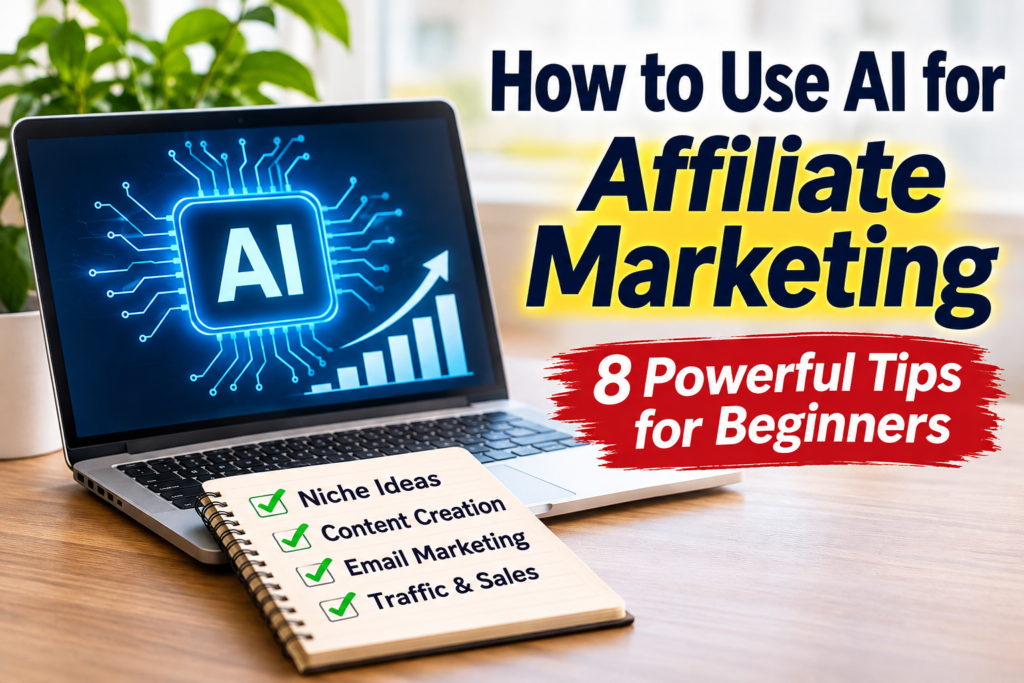

Affiliate marketing is one of the most popular ways to start an online business. You don’t need to create your own products, handle customer service, or manage inventory. Your job is to connect people with products that solve their problems and earn a commission when someone makes a qualifying purchase.
But getting started isn’t always easy.
You need to research products, understand your audience, create content, attract visitors, and learn how to turn that traffic into sales. For beginners, those responsibilities can feel overwhelming.
That’s where artificial intelligence (AI) can help.
Learning how to use AI for affiliate marketing can save time, simplify everyday tasks, and help you build a more organized online business.
The best part? You don’t need to be a technical expert to get started.
In this guide, we’ll explore practical ways to use AI for affiliate marketing, the mistakes to avoid, and how to build a simple workflow you can actually follow.
Table of Contents
- What Is AI Affiliate Marketing?
- Why AI Is Useful for Affiliate Marketers
- Step 1: Choose a Profitable Niche
- Step 2: Research Affiliate Products
- Step 3: Understand Your Target Audience
- Step 4: Create Helpful Blog Content
- Step 5: Use AI for Email Marketing
- Step 6: Create Social Media Content
- Step 7: Improve Your Affiliate Promotions
- Step 8: Track Results and Make Improvements
- Common AI Affiliate Marketing Mistakes
- How to Build a Simple AI Affiliate Marketing Routine
- Final Thoughts
What Is AI Affiliate Marketing?
AI affiliate marketing means using artificial intelligence tools to help with the activities involved in promoting affiliate products.
Instead of spending hours brainstorming blog topics, researching keywords, or drafting emails, you can use AI to help complete those tasks more efficiently.
For example, AI can help you:
- Generate ideas for blog posts and social media content.
- Research potential audiences and customer questions.
- Draft product comparisons and educational articles.
- Create email newsletters and follow-up sequences.
- Brainstorm advertising headlines and promotional angles.
- Organize marketing plans and content calendars.
- Analyze information from your marketing results.
However, there’s something important to understand.
AI is a tool, not a replacement for learning affiliate marketing.
You still need to choose worthwhile products, provide accurate information, follow advertising rules, and understand what your audience needs.
Think of AI as a helpful assistant that makes the work easier while you remain responsible for the business.
Why AI Is Useful for Affiliate Marketers
One of the biggest challenges beginners face is finding enough time to do everything.
You might have a full-time job, family responsibilities, or other commitments. Spending several hours every evening writing content simply isn’t realistic for everyone.
AI can make a meaningful difference.
It saves time
Instead of staring at a blank screen, you can ask AI to create an outline for a blog post or suggest several email subject lines.
You still review and improve the results, but you’re no longer starting from nothing.
It helps generate ideas
Running out of content ideas is a common problem.
AI can suggest topics based on your niche, audience, and the problems people want to solve.
It makes marketing more organized
You can use AI to develop weekly content plans, create checklists, and organize your promotional activities.
This is especially helpful when you’re managing several affiliate offers.
It helps beginners learn
You can ask AI to explain unfamiliar marketing terms, compare strategies, or walk you through a process step by step.
That doesn’t mean every AI answer will be correct. Important details should always be verified.
Step 1: Choose a Profitable Niche
Before promoting anything, you need to decide who you want to help.
Your niche is the particular market or audience your business focuses on.
Popular affiliate marketing niches include:
- Health and wellness
- Personal finance
- Home improvement
- Technology and software
- Hobbies and recreation
- Online business and marketing
The goal isn’t simply to choose the most popular niche.
You want a market where people have real problems, actively look for solutions, and are willing to spend money.
How AI can help
Ask an AI tool to brainstorm niche ideas based on your interests and experience.
Example prompt:
“Suggest 10 beginner-friendly affiliate marketing niches. For each niche, explain the target audience, common problems, potential content topics, and possible affiliate product categories.”
You can then narrow the list based on your interests and available resources.
Remember that AI-generated niche suggestions aren’t proof of profitability. You’ll still need to research actual products, competition, and customer demand.
Beginner tip: Choose one niche initially. It’s easier to build useful content for one audience than to promote unrelated products to everyone.
Step 2: Research Affiliate Products
Once you’ve selected your niche, it’s time to find products worth promoting.
You can explore affiliate networks such as ClickBank, individual company affiliate programs, and other established marketplaces.
But don’t choose a product based on commission size alone.
Consider the following questions:
- Does the product solve a genuine problem?
- Is the sales page clear and professional?
- Are the product claims believable?
- Does the vendor have a reasonable reputation?
- Are the affiliate terms and traffic restrictions clearly explained?
- Does the product fit your audience?
Use AI to organize your research
AI can help you build a comparison checklist for different offers.
Example prompt:
“Create a comparison checklist for evaluating affiliate products. Include audience fit, product quality, commission structure, refund policies, promotional restrictions, and customer support.”
You can use that checklist while researching products yourself.
AI should not be relied upon to invent or confirm current commission rates, vendor policies, or product performance. Always check the official affiliate information.
A good affiliate business starts with products you feel comfortable recommending.
Step 3: Understand Your Target Audience
One of the most common affiliate marketing mistakes is focusing too much on the product and not enough on the customer.
People generally aren’t searching for affiliate links.
They’re searching for answers.
Someone interested in better sleep might be researching bedtime routines, sleep environments, or ways to feel more rested.
Someone interested in affiliate marketing might want to know how to get started without building a website or creating a product.
Understanding those questions helps you create useful content.
Use AI to discover content angles
Example prompt:
“I’m promoting beginner-friendly affiliate marketing education. List 20 questions someone new to affiliate marketing might ask before purchasing a training program. Group them by beginner concerns, technical questions, and purchasing decisions.”
The results can inspire blog posts, emails, videos, and social media discussions.
You can also use search engines, forums, customer reviews, and keyword research tools to validate which questions people actually ask.
The more accurately you understand your audience, the easier it becomes to create content that matters.
Step 4: Create Helpful Blog Content
A blog can be a valuable long-term asset for affiliate marketers.
Unlike a social media post that may disappear from someone’s feed quickly, a useful article can remain available to readers for years.
For example, an article explaining how to start affiliate marketing can attract people who are researching the subject.
If your article answers their questions, they’re more likely to explore your recommendations.
How AI can help with blogging
AI can assist with:
- Brainstorming article topics
- Creating outlines
- Drafting introductions
- Organizing headings
- Suggesting FAQs
- Improving readability
- Writing meta descriptions
- Identifying opportunities for internal links
Here’s an example.
Example prompt:
“Create a detailed outline for a 1,500-word beginner-friendly blog article about starting affiliate marketing without creating a product. Include practical steps, common mistakes, and an FAQ section.”
Once you have the outline, add your own experience, research, examples, and recommendations.
That’s what makes the content more valuable.
Don’t publish AI content without reviewing it
AI can produce inaccurate statements, repetitive paragraphs, or information that sounds convincing but isn’t correct.
Before publishing, check facts, remove unnecessary filler, and make sure the article genuinely helps readers.
For more guidance, read my article on how to start affiliate marketing without creating your own product.
Step 5: Use AI for Email Marketing
Email marketing is one of the most useful skills an affiliate marketer can develop.
Instead of depending entirely on search engines or social media platforms, you can build a list of subscribers who have chosen to hear from you.
That gives you opportunities to share helpful content, answer questions, and recommend relevant products over time.
AI can help you write emails more efficiently.
Create welcome emails
When someone joins your email list, a welcome message introduces your business and sets expectations.
Example prompt:
“Write a friendly welcome email for new subscribers interested in affiliate marketing. Thank them for subscribing, explain what kinds of tips they’ll receive, and encourage them to reply with their biggest challenge.”
Develop educational email sequences
Rather than sending a sales pitch every day, create a sequence that teaches subscribers something useful.
For example:
- Welcome subscribers and deliver their free resource.
- Explain a common beginner mistake.
- Share a practical affiliate marketing tip.
- Teach a simple traffic-generation strategy.
- Introduce a relevant product when appropriate.
AI can draft these emails, but your personal experience and judgment should shape the final messages.
Build your list before you need it
Many beginners focus entirely on making their first sale and overlook list building.
An email list can help you maintain contact with interested readers even if a traffic source changes.
If you’re starting from zero, check out my guide on how to build an email list from scratch.
Step 6: Create Social Media Content
Social media is another area where AI can be especially helpful.
Whether you use Facebook, Pinterest, Instagram, or another platform, posting consistently takes planning.
AI can help you create content ideas without making every post sound like an advertisement.
Focus on useful posts
Consider sharing:
- Beginner tips
- Common mistakes
- Short educational explanations
- Questions that encourage discussion
- Helpful checklists
- Relevant personal experiences
For example, if you’re promoting a wellness-related offer, your posts might discuss healthy routines and general lifestyle habits rather than constantly pushing a product.
Example AI prompt
“Create seven short Facebook posts for an audience interested in affiliate marketing. Make each post educational, conversational, and easy to read. Include a question at the end of each post. Avoid exaggerated income claims and aggressive selling.”
You can edit the results to match your personality.
Consistency matters more than publishing dozens of generic AI-generated posts.
It’s better to share a few genuinely useful posts than overwhelm your audience with repetitive content.
Step 7: Improve Your Affiliate Promotions
Creating content is only part of affiliate marketing.
You also need to help readers understand why a particular product may be relevant to them.
This is where AI can help you communicate more clearly.
Turn features into benefits
A product feature explains what something includes.
A benefit explains why that feature matters.
For example:
Feature: A training program includes step-by-step video lessons.
Benefit: Beginners can follow a structured process instead of trying to figure everything out on their own.
AI can help you identify benefits, but those benefits must accurately reflect the product.
Create better promotional headlines
You can ask AI to generate headline ideas for an article, email, or advertisement.
Example prompt:
“Suggest 10 clear, curiosity-driven headlines for an educational article about using AI to simplify affiliate marketing. Avoid income guarantees, misleading promises, and exaggerated claims.”
Then select the headline that best matches your content.
Keep promotions natural
Readers are more likely to trust recommendations that fit the subject they’re already interested in.
For example, someone reading this article is learning how to use AI in affiliate marketing.
That makes it reasonable to introduce a resource designed to help beginners put those ideas into practice.
Want a more structured way to get started?
If you’re interested in using AI to build an affiliate marketing business, take a look at my AI Affiliate Starter Kit.
I created this resource to help people explore practical ways to combine AI tools with affiliate marketing.
It’s designed to give beginners a more organized starting point instead of leaving them to piece everything together from scattered information.
You can review what’s included and decide whether it fits your goals.
Explore the AI Affiliate Starter Kit
Step 8: Track Results and Make Improvements
One of the biggest lessons in affiliate marketing is that activity and results aren’t the same thing.
You might publish several articles, create social media posts, and send emails without immediately making a sale.
That doesn’t automatically mean your strategy has failed.
It means you need to look at the available information and understand what’s happening.
Metrics worth watching
Depending on your traffic source, useful metrics might include:
- Website visitors
- Affiliate link clicks
- Email subscribers
- Email open and click rates
- Advertising costs
- Confirmed sales
- Refunds
- Commissions earned
AI can help organize and interpret this information.
For example, you could provide a table of your weekly results and ask:
“Review these affiliate marketing results. Identify trends, possible problems, and three improvements I could test next. Don’t assume that correlation proves causation.”
Of course, the quality of the analysis depends on the information you provide.
And when you’re using paid advertising, tracking expenses is especially important.
A campaign isn’t profitable just because it generates clicks or leads.
You need to compare the money spent with the commissions earned, while accounting for refunds and other costs.
Common AI Affiliate Marketing Mistakes
AI is useful, but there are several mistakes beginners should avoid.
1. Publishing everything AI generates
AI-generated content should be reviewed, edited, and checked for accuracy.
Your readers deserve useful information, not automatically produced filler.
2. Promoting too many products
Trying to promote everything at once can make it difficult to build trust or understand what works.
Start with a focused audience and a manageable number of offers.
3. Ignoring affiliate disclosures
If you earn commissions from recommendations, disclose your affiliate relationships clearly.
Follow applicable FTC guidance, affiliate network rules, and platform policies.
4. Making unrealistic income claims
AI tools don’t guarantee affiliate sales.
Avoid promising easy money, automatic income, or specific financial results.
5. Depending entirely on AI
AI can help you work faster, but it can’t replace customer understanding, sound judgment, or consistent effort.
6. Changing strategies too frequently
It’s tempting to jump from one marketing method to another whenever a new tool appears.
But constantly switching directions can prevent you from learning any one method properly.
Choose a strategy, give it a reasonable test, measure the results, and improve from there.
How to Build a Simple AI Affiliate Marketing Routine
You don’t need to spend all day working on affiliate marketing.
A manageable routine can help you make steady progress, even if you’re balancing your business with a full-time job.
Here’s an example of a simple weekly schedule.
Monday: Research and planning
Spend 20–30 minutes reviewing audience questions, researching content ideas, and choosing your priorities for the week.
Use AI to brainstorm ideas and organize them into a short plan.
Tuesday: Create one useful piece of content
Work on a blog post, educational email, or other substantial resource.
Use AI for the outline and initial draft, then improve it with your own research and experience.
Wednesday: Social media
Prepare a few short posts related to your main content.
Keep them helpful and relevant to your audience.
Thursday: Email marketing
Write or schedule an email that shares something valuable with subscribers.
Include a relevant recommendation only when it makes sense.
Friday: Review your results
Look at website traffic, clicks, subscribers, and sales.
Identify one improvement to test the following week.
Weekend: Learn and improve
Use any available time to study a marketing skill, update an older article, or improve your website.
You can adjust this schedule to fit your circumstances.
The point isn’t to follow a perfect calendar.
It’s to develop a repeatable process you can maintain.
Final Thoughts: AI Makes Affiliate Marketing Easier, but You Still Have to Do the Work
Learning how to use AI for affiliate marketing can give beginners a real productivity advantage.
You can brainstorm ideas faster, organize your content, write better first drafts, and spend less time struggling with routine tasks.
But successful affiliate marketing still requires patience, useful content, trustworthy recommendations, and a willingness to learn.
You don’t need to master every tool or platform immediately.
Start with one niche, choose products carefully, build helpful content, and use AI to support your efforts.
As you gain experience, you can expand your marketing activities and improve your systems.
The goal isn’t to let AI run your business. It’s to use AI to help you build a better business.
And if you’d like a structured resource to help you get started, you’re welcome to explore my AI Affiliate Starter Kit.
Affiliate disclosure: This article may contain affiliate links. If you make a purchase through one of these links, I may earn a commission at no additional cost to you. Results vary, and no earnings are guaranteed.