
How to Get Free Traffic for Affiliate Marketing
One of the biggest challenges new affiliate marketers face is getting people to visit their websites, read their content, and click their affiliate links.
You can find an excellent affiliate product, create a professional website, and write a convincing recommendation. But without visitors, it’s difficult to generate sales.
That’s why learning how to get free traffic for affiliate marketing is such an important skill.
The good news is that you don’t necessarily need a large advertising budget to get started.
There are several ways to attract visitors without paying for every click. However, free traffic isn’t effortless traffic. It requires useful content, consistency, patience, and a willingness to learn.
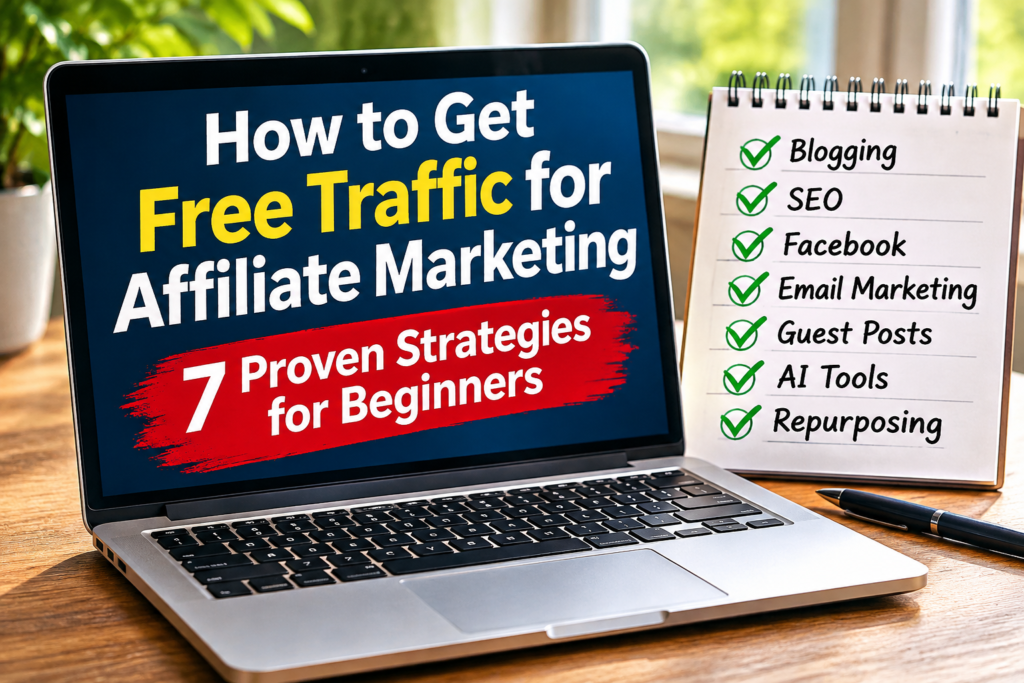
In this guide, we’ll explore seven practical traffic strategies beginners can use to build an audience and create more opportunities for affiliate commissions.
What Is Free Traffic in Affiliate Marketing?
Free traffic refers to visitors who discover your website, content, or affiliate promotions without you paying directly for advertising placements or clicks.
For example, someone might find your blog through Google, discover your Facebook post, or click a link in an educational article you’ve written for another website.
These visitors can become potential customers if your content addresses their needs and introduces relevant products.
Unlike paid advertising, organic traffic doesn’t require a daily advertising budget.
However, it still involves an investment of time and effort.
And although some methods can generate attention relatively quickly, building a dependable source of organic traffic often takes months rather than days.
Let’s look at seven strategies worth considering.
1. Start a Blog That Answers Real Questions
Blogging is one of the most useful long-term traffic strategies for affiliate marketers.
A helpful article can continue attracting readers long after you publish it.
For example, imagine someone searches for information about starting affiliate marketing without creating their own products.
If you’ve published a detailed article answering that question, your website has an opportunity to appear in relevant search results.
That visitor may then explore your other content, subscribe to your email list, or consider an affiliate recommendation.
How to create traffic-focused blog posts
Start by identifying questions your target audience is asking.
Look for topics such as:
- How to solve a specific problem.
- Beginner tutorials.
- Common mistakes to avoid.
- Product comparisons.
- Step-by-step guides.
- Helpful tools and resources.
Then create an article that genuinely answers the question.
For example, if you’re interested in starting an affiliate business, read my guide on how to start affiliate marketing without creating your own product.
A good blog post should help readers accomplish something, not simply encourage them to click an affiliate link.
Beginner tip: Focus on publishing useful articles consistently instead of rushing to produce large amounts of low-quality content.
2. Learn the Basics of Search Engine Optimization
Search engine optimization, usually called SEO, helps search engines understand your website and its content.
Good SEO practices can improve your chances of appearing in relevant search results.
However, SEO isn’t about stuffing keywords into every paragraph.
It’s about creating content that matches what people are searching for and making that content easy to understand and navigate.
Simple SEO improvements
Start with these basics:
Choose a clear focus keyword.
Your focus keyword should describe the main subject of your article.
For example, this article focuses on the phrase “free traffic for affiliate marketing.”
Write descriptive titles.
Your title should tell readers what they’ll learn.
Organize your content with headings.
Headings make longer articles easier to scan and help readers find specific information.
Add internal links.
Link to other relevant articles on your website so visitors can continue learning.
Write helpful image alt text.
Describe what your images actually show rather than adding unrelated keywords.
Improve readability.
Use short paragraphs, clear explanations, and examples where appropriate.
If you’re using WordPress, an SEO plugin such as Rank Math can help identify areas to improve.
But remember that a high plugin score doesn’t guarantee search engine rankings.
The ultimate goal is to create content that readers find useful.
3. Use Facebook to Build an Interested Audience
Facebook can provide opportunities to connect with people interested in your niche.
You don’t necessarily need a large following to begin.
A Facebook page allows you to publish educational posts, share helpful information, and give interested visitors a reason to learn more about your business.
What should you post?
Instead of constantly promoting affiliate products, consider sharing:
- Short educational tips.
- Answers to frequently asked questions.
- Helpful checklists.
- Common mistakes.
- Relevant industry observations.
- Questions that encourage conversation.
For example, if your niche is affiliate marketing, you could publish a post explaining three mistakes beginners make when choosing products.
Someone who finds that information useful may visit your page or website.
Avoid turning every post into an advertisement
People generally follow pages because they’re interested in the content.
If every post is a sales pitch, you may struggle to build engagement.
Try to provide value first and introduce relevant recommendations naturally.
Also, remember that organic reach isn’t guaranteed. Some posts may receive very little attention.
Consistency and relevance are more useful than chasing viral results.
4. Build an Email List From the Beginning
An email list is one of the most valuable assets an affiliate marketer can develop.
While email marketing itself isn’t technically a source of new visitors unless people discover your signup page elsewhere, it can bring previous visitors back to your website.
That’s an important distinction.
Someone might discover your blog through Google, subscribe to your newsletter, and later return when you email them about a new article.
Instead of losing contact with that visitor, you have an opportunity to build an ongoing relationship.
Offer something useful
A simple way to encourage subscriptions is to offer a free resource related to your niche.
This might be:
- A short beginner’s guide.
- A checklist.
- A useful report.
- A collection of practical tips.
- A short email course.
The resource should solve a problem your audience actually cares about.
Choose an email marketing platform
You’ll also need an email marketing service to manage subscribers, deliver messages, and organize follow-up campaigns.
One option worth exploring is AWeber.
AWeber provides tools for creating signup forms, managing email lists, sending newsletters, and setting up automated email sequences.
For beginners, having these tools in one place can make it easier to stay organized and communicate consistently with subscribers.
You can explore AWeber here and see whether it fits your needs and budget.
Send helpful follow-up emails
Once someone subscribes, don’t immediately overwhelm them with promotions.
Start by delivering the promised resource.
Then share educational content, answer common questions, and recommend relevant products when appropriate.
If you’re new to email marketing, I explain the process in my article on how to build an email list from scratch.
Building an email list takes time, but it gives you a way to reconnect with people who have already expressed interest in your content.
5. Write Guest Posts for Relevant Websites
Guest blogging involves writing an article for another website in your niche.
It can be an effective way to introduce yourself to an established audience.
For example, if you write about affiliate marketing, you might contribute an educational article to a website that covers internet marketing or online business.
Readers who appreciate your advice may want to learn more about you.
What makes a good guest post?
A strong guest article should:
- Offer original, helpful information.
- Match the website’s audience.
- Be easy to read.
- Avoid excessive promotion.
- Follow the publisher’s submission requirements.
Some websites allow a short author biography with a link back to your website.
That can give interested readers a natural way to discover your content.
However, don’t assume every website accepts guest posts or permits promotional links.
Always check the publisher’s rules.
Learning from experienced marketers
Another way to develop your skills and discover opportunities is to learn from experienced marketers.
For example, John Thornhill’s Ambassador Program is an option for people interested in internet marketing education, mentorship, and building their online businesses.
Programs like this may provide training, guidance, and opportunities to develop your marketing skills.
Of course, joining a program doesn’t automatically produce traffic or sales. You still need to apply what you learn.
The important thing is to combine education with consistent action.
Focus on relationships, not just backlinks
Guest posting works best when you contribute something genuinely useful.
The goal should be to help the host website’s readers and establish your credibility.
Any referral traffic is an additional benefit.
6. Use AI to Create Content More Efficiently
Artificial intelligence tools can make content planning and creation easier.
For affiliate marketers who have limited time, this can be particularly helpful.
You can use AI to brainstorm topics, create outlines, draft social media posts, and organize email ideas.
But AI doesn’t automatically generate traffic.
The value comes from using it to create content that genuinely helps your audience.
Practical AI prompts for traffic generation
Here are three examples.
Blog topic research:
“Suggest 15 beginner-friendly blog topics about affiliate marketing. Focus on questions people might search for when starting their first online business.”
Facebook content planning:
“Create seven educational Facebook post ideas for beginners interested in affiliate marketing. Keep them conversational and avoid exaggerated income claims.”
Content repurposing:
“Turn this blog article into five short social media posts. Each post should highlight one useful takeaway and encourage readers to learn more.”
After generating content, review it carefully.
Add your own examples, verify important information, and remove anything repetitive or misleading.
For more practical ideas, read my guide on how to use AI for affiliate marketing.
Want help getting started with AI affiliate marketing?
I created the AI Affiliate Starter Kit as a resource for people interested in combining AI tools with affiliate marketing.
If you’d like a more structured introduction to the process, you can explore what’s included and decide whether it’s right for you.
7. Repurpose Your Existing Content
You don’t always need to create something completely new to attract visitors.
One useful blog article can become the foundation for several pieces of content.
For example, suppose you publish a detailed article about building an email list.
You could turn that article into:
- A short Facebook post.
- A newsletter for your subscribers.
- A beginner checklist.
- A series of educational tips.
- A short video script.
- A discussion topic for an appropriate online community.
Each version can introduce the same core idea to a different audience.
Make each version useful on its own
Avoid simply copying and pasting the same text everywhere.
A Facebook post should be shorter and more conversational than a detailed blog article.
An email should feel personal and provide a reason to click through.
A short video should focus on one clear takeaway.
You can use AI to help adapt the content, but review every version before publishing.
Don’t forget older articles
Content repurposing also provides a good reason to revisit posts you’ve already published.
You might discover an older article that needs clearer headings, updated information, improved internal links, or a better introduction.
Refreshing useful content can be just as worthwhile as creating something new.
How Long Does Free Affiliate Traffic Take?
This is one of the most important questions beginners ask.
Unfortunately, there’s no universal timeline.
A Facebook post might attract visitors the same day, while a new blog article could take much longer to gain search visibility.
Some content may never attract substantial traffic.
Results depend on factors such as:
- Competition in your niche.
- Content quality and relevance.
- Website authority.
- Search demand.
- Distribution methods.
- Audience interest.
- Consistency over time.
That’s why it’s important to measure what happens rather than assume every strategy will work.
For a new website, the early stages may involve more learning and content creation than actual traffic.
That can be frustrating, but it also provides opportunities to improve.
Free Traffic vs. Paid Traffic: Which Is Better?
Both approaches have advantages.
Free traffic
Organic methods generally don’t require you to pay for each visitor.
They can also help you develop valuable skills and build content that remains available over time.
The downside is that results may be slow or unpredictable.
Paid traffic
Paid advertising can help you reach a targeted audience more quickly.
However, every campaign involves financial risk.
Clicks and leads don’t guarantee commissions, and advertising expenses can exceed your earnings.
For beginners with limited budgets, learning organic traffic strategies can provide a useful foundation.
Paid advertising can be explored when you’re ready to understand tracking, testing, and campaign performance.
Neither method guarantees success.
A Simple 30-Day Free Traffic Plan
If you’re feeling overwhelmed, start with a manageable plan.
Week 1: Build your foundation
Choose your main niche and identify the audience you want to help.
Research five common questions those people ask.
Use those questions to plan your first few pieces of content.
Week 2: Publish useful content
Create one detailed blog article that answers a specific question.
Make sure it has a clear title, organized headings, and relevant internal links.
Share the article where appropriate.
Week 3: Expand your reach
Create several short social media posts based on your article.
Consider offering a useful free resource to encourage email subscriptions.
Focus on helping readers rather than promoting products aggressively.
Week 4: Review and improve
Check your available website and email statistics.
Look at which articles received visitors, which links attracted clicks, and which topics generated interest.
Then choose one improvement to make.
You don’t need to accomplish everything in 30 days.
The purpose of this plan is to establish a routine you can repeat.
Common Free Traffic Mistakes to Avoid
Before finishing, let’s look at several mistakes that can slow your progress.
Expecting immediate results. Organic traffic often takes time to develop.
Promoting unrelated products. Keep your recommendations relevant to your audience.
Publishing low-quality content. Focus on useful information rather than producing articles simply to increase your post count.
Ignoring email marketing. Give interested readers a way to stay connected.
Using spammy promotion methods. Avoid dropping affiliate links into unrelated discussions or groups.
Changing strategies constantly. Give each reasonable approach enough time to collect useful information.
Ignoring your results. Review what happens so you can make informed improvements.
Final Thoughts
Learning how to get free traffic for affiliate marketing is an important step toward building an online business.
Blogging, SEO, social media, guest posting, email marketing, AI-assisted content creation, and content repurposing can all contribute to a broader marketing strategy.
You don’t need to master every method at once.
Start with one or two approaches that fit your available time and resources.
Create helpful content, learn from your results, and make improvements as you gain experience.
Most importantly, remember that affiliate marketing is about helping people find solutions.
The more useful your content becomes, the more reasons people have to discover, trust, and return to your website.
Affiliate disclosure: This article contains affiliate links, including links to AWeber, the Ambassador Program, and other resources. If you purchase through these links, I may earn a commission at no additional cost to you. Results are not guaranteed.